Thursday, September 25, 2014

Marijuana Use and Negative Externalities

Amendment 64

Amendment 64 in Colorado, which legalized recreational marijuana use in Colorado for those over 21, has been perhaps produced the most interesting conundrum of legal issues in Colorado in recent history -- and it's not just the fact that marijuana is still illegal federally.

Cannabis Tourism (All Aboard the Canna-Bus?)


Legal issues aside, however, the legalization of marijuana has succeeded most in one area:  boosting tourism in Colorado, particularly those areas that have legal marijuana dispensaries such as Denver.  According to CNN Money, in the first half of 2014, Colorado took in $19 million dollars in tax revenue from legal marijuana alone, giving some idea to the magnitude of this industry.  Unfortunately, this number doesn't differentiate between in-state and out-of-state purchasers.  However, some dispensaries estimate that upwards of 1/3 of their business is from out-of-state tourists.

Issues with Cannabis Tourism

But the problem here?  This article brings up the fact that there really isn't anywhere for tourists to use their legally-purchased marijuana.  Some examples:
  • Out-of-state tourists can't go home and consume their marijuana - they aren't legally allowed to cross state lines with their marijuana
  • They can't consume the marijuana in the place where they buy it - it is illegal to consume marijuana at the dispensary which they purchase it at.  Also, dispensaries are not allowed to sell any other sort of cannabis-free food or drink, so they are not particularly destinations to spend time at.
  • Bars and restaurants are off limits - consuming marijuana, like cigarettes, is prohibited in bars and restaurants.  Outdoor patios are also off limits because Amendment 64 prohibits the use of marijuana out in the open in public.
  • But what about the hotel? - most hotels are smoke-free, and marijuana-smoke-free, as well.  They just don't want to deal with it. And they have that right.

What Does Economics Have to Do With This?

Negative Externalities

An externality exists when the market transaction - a consumer purchasing and consuming marijuana from a supplier - creates a consequence that affects an unrelated, third-party individual.  A negative externality is when this consequence adversely affects the third party.

When done publicly, consuming marijuana can thrust several of these negative externalities upon society, especially with regard to clean air.  For example:
  • People don't like the smell
  • The fumes do have the ability to adversely affect those who breathe it in (aka, a contact high)
Because of these various negative externalities, government regulation has been used to concentrate the use of marijuana into private spaces.  But this is complicated when marijuana tourists have a lack of access to "private" places.  And that's problematic with as large of as industry as cannabis tourism has become.

Fixing Negative Externalities

In a traditional sense, the easiest and most common fix to a negative externality is to make it more expensive, since negative externalities are caused by the fact that we consume a good or service at a higher equilibrium quantity than what we ought to demand, socially.  This expense comes from taxing things at higher rates.

The problem here, though, is the fact that the market price of marijuana is difficult to determine because it is such a new market.

So Where Does that Leave Us?

This leaves us in a place of business doing what they do best - sort of ignoring rules.  "420-friendly" concerts and events are becoming increasingly popular as a means of creating atmospheres for public marijuana use where the behavior is not condoned, but it is not prohibited either.  It's a gray area.  It's right where this issue lives best.

Other options are hotels and other "private" clubs and businesses where marijuana use is allowed as these establishments are not open to the public and therefore work around 'open-to-the-public' aspect that usually prohibits marijuana use almost everywhere else.

But like all else with this messy issue, as it comes to resolved, it will be nothing but interesting.

Thursday, September 18, 2014

Is Water Being Left Behind?


In many ways, water doesn't seem much different than oxygen.  It is necessary for life, it's almost everywhere, and it seems difficult to keep people from using it if it's there.  And in many ways, that's true.  But the key comes when the consideration of safe drinking water is added.  Then it becomes more complicated.

But before we get ahead of ourselves, we need to take a minute and look at two aspects of any good (or service).

How Goods Are Good (Or Something Like That)

Excludability and Rivalry

All goods and services can be characterized by two different characteristics:  excludability and rivalry.  These mean:
  • Excludability - the ability to prevent someone from using a good or service
  • Rivalry - the idea that if someone uses a good or service, then someone can't use it
In general, goods where you can prevent someone from using it is an excludable good; and conversely, a good where it is difficult to prevent others from using is called nonexcludable

Goods where the use by one person prevents another from using are characterized as rival, whereas goods that aren't depleted by one person's use are nonrival.

Setting the Table

We can combine these two traits together into a table, and through that we can come up with four distinct categories of goods/services:

Admittedly, each category of goods has its downfalls.  But the problems with public goods are perhaps the most prominent.

Which is where water comes back in.

Why Clean Water Is Important

 As mentioned above, water in and of itself is a pure public good.  It is incredibly difficult to stop anyone from consuming water of some sort.  Also, one person's use of the overall water system is generally non-rival because it doesn't prevent someone else from enjoying water. (Also, remember, the water you drink in modern times is just purified dinosaur pee.  Or something like that.) 

But what we are ignoring with the idea of water as a public good is the idea that people need clean drinking water.  They need water that is free of bacteria, microbes, and other things that can make them sick.  And without proper sanitation or resources, that is much easier said than done.  Now, clean drinking water is still a public good.  It is still relatively hard to prevent people from accessing clean drinking water, given both access points and cultural norms that establish clean drinking water as a right. 

But producing clean drinking water is expensive.  The market for this, left to its own devices, always delivers an unfavorably small amount of clean drinking water.  Which creates justification for government intervention to produce affordable and plentiful supplies of clean, municipal drinking water.

Missoula, MT

In truth, Montana is a bit of a weird state - that's mostly what I learned when I lived there for a couple months.  The stars at night are beautiful, I've never seen as many trees in my life, and beer flows freely (a lot like water).  And like any agricultural state in the Western United States, water is an especially important resource.

This is probably water, but it could be beer if it's in Montana.


Now, like almost every other city in the United States, Missoula, MT provides the service of providing safe, clean drinking water to its citizens.  But like many other cities, Missoula was also fundamentally affected by the recession in 2008.  As tax revenues to the city declined, providing the same amounts of services became difficult.  Even as economic conditions have improved, Missoula had fallen deeper and deeper in debt.  So they looked for ways to provide the same services at lower costs.

In municipal governments, this is often done through privatization of services, such as municipal waste, or water purification.  And this is exactly what Missoula did, as you can read about here.  Recently, the water rights for the entire Missoula Valley were sold to private corporation the Carlyle Group.  This has the potential to benefit Missoula citizens because privatization will likely lead to improvements in water infrastructure, and the same clean water for less money.  But the problem?  It's now a private company profiting, which makes water much more excludable than it was before.  And this shifts clean water from the public goods category into the club goods category.  And whether this will be good or not depends on several variables.  So we will see.

Thursday, September 11, 2014

The Solution to Your Evening Commute - An Economic Approach

I've seen this image posted on several websites already:


It is obviously a post geared at showing the benefits of alternative transit (buses, bikes, light rails, etc.), but it opens up the opportunity to talk about the greater topic that is transportation, and more specifically, traffic congestion.  

We all know what traffic congestion is:  it's what makes it inconvenient, annoying, stressful, and sometimes unsafe to drive places.  It is a pervasive problem in many urban areas around the world, and with increasing amounts of the world's population center shifting to urban areas, it seems increasingly impossible to fix this problem.

But it can be done.

But First...

Of course, first we have to ask one question:  how does traffic occur?  The Federal Highway Administration explains:
"Congestion results when traffic demand approaches or exceeds the available capacity of the system."
In translation, this means that traffic congestion is caused by the fact that the miles of road in the United States is relatively constant.  Even in the face of small increases in road miles every year due to construction, this finite space is divided into smaller and smaller portions with each new driver who backs out of their drive way.  The problem then boils down to the fact that traffic congestion is a side effect of the fact that there isn't enough road for everyone who wants to drive on it.


How Do We Fix It?

Traffic congestion is something of a many-faceted problem, and the true solution to improving traffic congestion in any community requires a myriad of tools.  But here we are back to discussing tools.  Not the type you can buy at Home Depot or Lowe's, but our handy, dandy Economic policy tools.  Let's begin to discuss some of the tools we can find in our tool box.


Increasing the Supply of Road

In many ways, the most straightforward policy tool one could suggest to alleviate traffic congestion would be to widen the roads.  Traffic congestion is caused by a lack of drivable space, so the quickest way to fix the problem would be to increase the amount of drivable area.  

Now the important part of any policy tool is to realize and weigh the pros and cons of each possible solution.  Let's discuss:

Pros

  • Keep it Simple, Stupid - It is the simplest, most straightforward way to fix the problem
  • Certainty - It is the most certain solution to fixing the problem
  • Keeps Taxpayers Happy - It is the most politically viable solution to be supported by taxpayers

Cons

  •  Construction Takes Time - Usually the best the construction of new roads can do is to keep pace with the problem
  • There Isn't Room - In some places with the worst traffic congestion, road widening is also the least feasible simply because there is not room to widen roads due to preexisting buildings and infrastructure
  • Well, I Used to Take the Bus... - Widening the roads may cause draw out induced demand by incentivizing people who used to walk, or take the bus, to now drive.  This means that widening the roads will only maintain the status quo as roads get wider, which does not help fix the problem.
  • Nobody Likes Construction - This speaks for itself.

Creating Legitimate Substitutes Goods

This solution works by creating goods and services that are legitimate alternatives, or substitutes, to driving and work to reduce the demand for driving cars.  This looks like reducing the number of vehicles on the road by finding ways to put more people in one vehicle, or by creating modes that don't use the road at all. 

Some examples:

Public Transportation

Public transportation is a network of transportation modes that provides service on fixed routes that run on fixed schedules.  According to the American Public Transportation Association, this goes beyond buses, though, to include some modes such as:
  • Light rails
  • Subways
  • Street cars
  • Ferries
  • Commuter trains
  • Trollies
  • And yes, buses

Bicycles / Bicycle Infrastructure
 
The encouragement of biking and the provision of adequate, safe bike infrastructure allows commuters the luxury of their own 'vehicle' and choosing their own route, while also providing a mode of transportation that is cheaper, more versatile, and an alternate to driving.  

Car Pooling / Ride Sharing
This alternative matches people who have relatively common departure and arrival areas to their commute, and allows them to commute in one vehicle versus the several vehicles that would be necessary if each person were driving their own car.  Furthermore, this option also allows individuals to split money for gas, and allows the driver to be compensated for wear and tear on their car in a way that may be profitable to them.

Assessing the Policy Solution

 Of course, each of these examples of creating substitute good to driving has its own pros and cons, though this group as a whole shares some common pros and cons.

Pros:
  •  Creates Alternative Options - Even though people may not want to drive, they are forced to if there is no other option.  Creating these other options is important to achieving the goal of reducing traffic congestion.
  • Reduces Harmful Tailpipe Emissions - This is a fancy way of saying that public and alternative transportation modes like these work to reduce carbon emissions either by exploiting economies of scale by putting more people in one vehicle or by using modes that produce fewer emissions - such a bicycle, which produces no emissions.
  • Creates Equal Access - Because many of these substitute forms are cheaper than owning a car, it works to create equal access to transportation for more people.  This is beneficial because it allows people to pursue better careers and educational opportunities than they may otherwise be able to.
Cons:
  • Public Goods - In conjunction with the fact that many of these modes are public goods, or are facilitated by public infrastructure, the truth of the matter is that they are not profitable ventures most of the time. Which makes them...
  • Politically Unpopular - People like public transportation once it is there.  They just don't like to pay for the investment to get it there.  This is typically a phenomenon known as latent demand, where demand is created for a good/service because it is there, rather than the supply being derived partially from preexisting demand.  This is complicated because people like the idea of moving forward with these alternatives, but they are less likely to come to fruition because there is not money to fund the projects.
  • Consistency is a Must - Admittedly, the one caveat to creating legitimate substitutes to driving is that these modes must be dependable.  With public transportation, this means that routes must be expansive, timely, and usually run through longer hours of operation.  Bike routes must be contiguous and create space for both bicyclists and cars to feel safe.  All of this is fighting an uphill battle at times both politically and financially.

 Price Incentives


The final tool economists possess that can help fix traffic congestion is the Duct Tape in the tool box discussed last week:  price incentives.  Because driving in this instance creates several negative externalities - pollution and traffic congestion - then the logical solution is to 'tax' driving and make the market price of driving more expensive.  Some possibilities include:
  • Increase Car Registration Fees
  • Increase Gas Taxes - Increasing the price of gas would incentivize people away from driving as much, and may prompt them to make alternative transportation choices such as those alternatives above.
  • Paid Parking - Paying to park in high-traffic, public places like malls, colleges, or downtowns works to make it more complicated to park once a consumer arrives at their destination.  This may make them rethink their form of transportation before they leave their house - especially if public transportation hubs are clustered in the same areas as paid parking.
  •  Initiating Tolls in Very Congested Areas- This assigns a cost to something that was a public good before.  By assigning a price to some of the most congested places, some people will still be willing to pay to use that stretch of road.  But other people will be willing to take alternate routes, or will choose other transportation alternatives.

Pros

As normal, there are pros and cons to be assessed with any group of policies:  
  • Choice - These mechanisms work to correct the problem while also providing free choice that people value very highly in most countries.  This goes away from telling people ho wot commute. 
  • Potentially Profitable - These mechanisms have the potential to be profitable and earn money to offset many of the issues that exist with driving, such as pollution, inadequate infrastructure, or other funding needs. 
  • Adjustable - Because these constructs are often intangible, they are relatively inexpensive to implement and are adjustable to changing tastes and needs in the economy.

Cons

  •  Responsiveness - People may not respond to the price incentives as expected.
  • Potentially Creates Socioeconomic Barriers - These price incentives may create further barriers to equal transportation for those who are lower income.

The Real Solution

The real solution to combating traffic congestion likely falls in the middle of these several policies, and a true solution uses a variety of these tools.  Unfortunately, Duct Tape may work somewhat well, but some chewing gum and maybe a hammer is necessary to truly fix the problem.  The chosen combination of these policies is very situational and depends on resources, culture, and political climate in a given community.  

Generally, though, the solution must make driving more difficult and provide a legitimate alternative to driving.  However a community chooses to implement this is variable, but the end should be the same.  That's the only way this is really going to work.

Thursday, September 4, 2014

Plastic Bag Bans and Economic Duct Tape

The City of Fort Collins just did something sort of weird.  In August, the Fort Collins City Council passed an ordinance that requires retailers to start charging for disposable bags, a.k.a. plastic and paper bags*.  The fees go into affect on April 1, 2015.  You can read the entire ordinance here or a more palatable FAQ here, but the main points are:
  • Retailers are to charge customers a minimum of $0.05 per disposable bag they use.
  • The fee will go to the retailer.
  • At least 50% of the fee must go toward providing free reusable bags to customers as the retailer sees fit.
  • Retailers must get permission from the customer to give them disposable bags.
  • Some exceptions to this rule include:
    • Restaurants
    • Farmer's Markets
    • Bulk items
    • Bags containing raw meat, frozen foods, or unwrapped items such as bakery goods
    • Prescription medicines
    • Newspaper delivery bags
'Bans' like these are not entirely new.  Over 133 communities around the United States already have a similar ban in place.  Several examples include: Austin, TX; San Jose, CA; Washington, D.C.; Basalt, CO; Boulder, CO.  Speaking to the success of these fees for plastic bags, Boulder, CO has reduced their use of disposable bags by 68% since their $0.10/bag fee went into effect in July of 2013 (see information here).

But why is this a concern?  Why is this a thing?

Plastic Bags are Bad.  
Each year, we use billions of them as a planet.  Disposable in nature, these bags accumulate in landfills, or blow away in the wind and end up as litter and trash in the ocean. This pollutes our oceans, and make it easy for wildlife to mistake the plastic deathtraps as food, which doesn't do much for their digestive systems.  Furthermore, these bags take a very long time to decompose in landfills.  Even though this is a very rough description of the problem, all of these factors mean that the problem is only growing as time progresses.


So again:  plastic bags are bad.  And it seems like the simplest solution would be to simply stop using them.  Ban them.  Prevent people from using them to carry their groceries and purchases home.  

But it isn't that simple for a couple of reasons:
  • People don't like being told what to do.  People don't respond well to being outright told what they can and can't do.  They want to be asked if they want their milk in a bag at the grocery store.
  • People need to carry their purchases in something.  Think of something as simple as going to the grocery store.  Think of how full your basket is as you wheel it toward the check out stand.  Now think of how you would get all of that home without something to carry them in.  And then try and figure how you would do that on the city bus, or on a bike.  Yeah...
  • Plastic bags are cheap and convenient.  It is simple to suggest the solution of switching to another reusable or more recyclable/decomposable container to carry everything in.  This is the best solution, of course, but plastic bags are so cheap and convenient.  Plastic bags ensure that people don't need to remember their reusable shopping bags every time they need to stop by the store.  They are cheaper than boxes or paper bags.  In short, they are the cheapest solution to people's laziness and forgetfulness.
But they are still bad.  So if we can't ban them, then how can we get people to stop using plastic bags?  

Economics Has an Answer (And Duct Tape)

 
If Economists had tool boxes, incentives would be their duct tape.  Incentives can fix everything (except a leaky pipe). 

Externalities
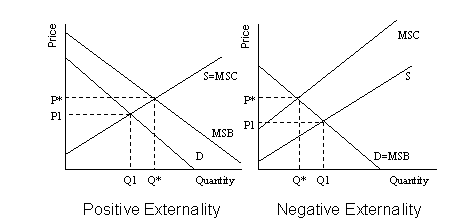
In society, there are times when we demand more of a good or service than we really ought to.  Examples of this include fast food, or cigarettes.  The opposite is also true, where we don't demand as much of something as we ought to.  This happens with things like education.  The technical term for this phenomenon is an externality.  For all you budding economists, you can see this concept in this chart:


Now Back to Discussing an Economist's Duct Tape
The concept of the Economic incentive is typically put into action through government policy that hits people/corporations where it often hurts the most - their wallet.  In the simplest terms, this looks like using taxes to increase the market price for things that are bad for society - like pollution - and provide subsidies to make good things cheaper - like education.  This use of incentive causes the equilibrium quantity of 'bad' things to decrease, and the market equilibrium quantity of 'good' things to increase.

What does that have to do with plastic bags?
It is clear that society demands too many plastic bags.  With the previous section in mind, one logical policy solution to incentivize people away from using so darn many plastic bags is to charge money for them and assign a cost to the convenience they provide.  Within this, some people will still be willing to pay a price for the convenience they provide, but other people will choose to avoid paying for plastic bags by bringing reusable bags or other containers to carry their purchases in.  Depending on how expensive those bags are, more people may make the choice to start bringing their own bags. (In Economics-speak: basic supply and demand.)

The result?  Those people who are bringing their own bags aren't using the plastic ones, which leads to fewer plastic bags left to float away in the breeze.  Huzzah, victory!  (We deserve a gold star.)


Assessing the Pros and Cons
Of course, as with every policy solution, there are pros and cons to this policy solution.  Here is a summary:

Pros:
  • People use fewer plastic bags.
  • Pollution is reduced.
  • Reusable shopping bags are less likely to break compared to their thin, plastic counterparts.
  • People have a choice in whether they give up plastic bags or not.
Cons:
  • People may forget their reusable shopping bags at home, anyway.  I know I do.
  • With regard to cloth reusable shopping bags, if they are not regularly washed, it increases the chance of spreading food-born illnesses such as Salmonella if other foods are put into bags that once contained raw meat or vegetables.
  • They cost money, which may create an additional burden on low-income individuals and families.
 So in short, that's why the City of Fort Collins wants to ban plastic bags.  And paper ones, too.


*This article primarily discusses why plastic bags are bad, even though most 'bans' address both plastic and paper bags.  Plastic bags are worse than paper bags in terms of environmental sustainability, yes.  Although paper bags are recyclable and biodegradable, they are still targeted by these bans because they create waste and they create incentive to use some sort of disposable bag.  Also, the processes used to make paper bags is relatively resource-heavy.