Tuesday, December 9, 2014

Realizing We're Screwed... And Other Lessons

"My home's with the hills and trees around me. My ceiling holds the moon and stars above." - from Whiskey by Trampled by Turtles
Ignore the song title above, but the quote is perfect.

I have lived in Colorado my entire life, except for the two and a half months this past summer I lived in a tiny town in rural, Granite County, Montana.  In those two and a half months 'abroad' from my home state, I learned several things.  Mostly, I learned that I am a city girl.  But I also learned that I am irrevocably drawn to the mountains - both here and in Montana. 

See, I love the ability to get a decent cup of coffee, and amenities like Walmart.  I love a crowd of people window shopping.  I love the exhilarating rush of nearly getting run over by a car at an intersection. I love the ability to go and get a haircut or go to the post office without taking time off work.

But I also love the mountains.  A lot.  I am quite lost without them (and not only because I don't know which way is west).

But this wasn't the moment I really realized that protecting the environment is important. 

I came back to school with all these thoughts in my mind.  And as I sat in environmental economics at the beginning of the semester and was reminded of the oh-so-simple concept of opportunity cost, I finally realized that opportunity cost was perhaps the most true thing in all of economics (because assuming that all people are rational is a little naive). Now, I can look over and see the mountains and the beautiful Colorado sky out the window.  But climate change is a reality.  I don't know why people feel the need to argue about it anymore.  And so opportunity cost made me realize that, as it stands, it's either the environment or our consumerism and growth.  It is us versus the mountains, in a way.

And though I've learned about opportunity cost and natural resources and sustainability several times over throughout my education, that was the first time I realized the gravity of the situation.  I realized how it all fit together, in a way.

And I really don't like it.  Because I know how the world should work.  But our chances of actually working toward it? I'm not sure I'm very optimistic.


Thursday, November 20, 2014

Saving the Environment, One Pinterest DIY Tutorial at a Time

For as often as we talk about saving the planet, as a species, we often fall into the category of 'all talk and no action'.  We talk about taking the bus once in awhile, or using reusable shopping bags, or recycling.  But this often falls short of turning into legitimate action to reduce our impact on the planet.  Basically, we are incredibly good at avoiding what we should do most of time.  For example, am I eating tortilla chips for dinner?  Yes, yes I am.  (They were a vegetable at one time, right?)


But sometimes, the things we should do come in the disguise of something we want to do.  One way this occurs:  Pinterest.

Now, of course, we all know that the main purpose of Pinterest is so women can plan their future weddings in digital splendor, from dress, to ring, to colors.  Of course, I'm kidding. (A little).

But one thing Pinterest is also really good at is providing users with endless 'do it yourself', or 'diy' tutorials for everything homegood and craft-related.  Do you want to learn how to stain wood using ingredients like tea, vinegar, and hydrogen peroxide?  There's a tutorial for that, here.  Do you want to make a bowl out of an old record? You can learn how to do that here. (I've tried this one before, pictures below.  It's actually pretty easy and turns out well.)  How about a windchime made out of old beer bottle caps? Here's a tutorial for you. (Actually, this one is cool, too.  It took forever to save the caps, but there's a picture that, too.)


I made this, for some reason.

I made this, too.


Now, most of these crafts seem rather pointless.  But they have one thing in common: reusing materials that would otherwise be thrown away.  Reusing, recycling, and repurposing are all major themes that unite the many tutorials of Pinterest.  And this is important because it provides a way for everyday people to reduce their impact on the environment by reducing the sheer amount of things they send to the landfill each year.  And not in a way they should -- in a way they want to.  Admittedly, the impact of this is only minimal, but it is better than nothing.

Furthermore, the proliferation of Pinterest in everyday society shows that the concepts of diy, and finding ways to turn our trash into treasure are something that people are interested in.  It shows a cultural shift to being concerned about what we throw away, what we use in our homes, and how that affects the environment.  And more important than any number of beer bottle windchimes or paper flowers, this cultural shift will be what puts us on a path to being more sustainable going into the future.  Which is what we really need.

Yeah, I made these, too.


Yeah, at this point I'm just bragging a little bit.

As an added bonus, I had to find a way to incorporate this video into my blog.  This is a perfect representation of the true emotional connection to crafting -- a lot of love, but an even greater amount of trial and error and cussing.  (Warning: video contains mild, edited profanity.)

Wednesday, November 5, 2014

Noise Pollution

Noise Pollution

Of all the types of pollution, noise pollution is one of the most abstract forms.  It doesn't make sense that sound can be likened to CO2 emissions or smog.  It seems strange because it usually doesn't directly harm anyone directly -- it's just really really annoying. 

So noise... pollution?


Noise pollution isn't just being made to listen to Nickelback ad nauseum.  Noise pollution occurs when loud noise disrupts or harms the balance of life for both humans and animals. Some of normal culprits include:
  • Cars
  • Airplanes
  • Outdoor concerts and events
  • Parties
  • Manufacturing facilities

The Effects

In more concrete terms, sound becomes noise pollution when it begins to disrupt sleep, conversation, or hurts an individual's overall health (according to the EPA).  Over longer periods of exposure, noise pollution can contribute to many adverse health effects, including:
  •  High blood pressure
  • Stress
  • Sleep loss
  • Hearing loss
  •  Speech interception

Noise as Pollution

Like all forms of pollution, noise becomes noise pollution at levels when the private marginal cost of more noise is different than the social marginal cost of the same noise.  The way that noise pollution differs from different forms of pollution is that it is more difficult to tell how much is too much.  It is possible to determine safe levels of many pollutants and from there create guidelines for lessening the amount of that pollutant overall.  Noise is much trickier because it is largely subjective to each individual.  While we can determine noise levels that lead to hearing loss, the lack of more instant physical harm associated with noise means that one person's rock concert is another person's noise pollution. 

Some Solutions

Admittedly, most of the solutions to noise pollution come from trying to remove the sources of noise, or from moving pollutees away from the source.  As with rock concerts or even bars, it is less typical to find housing right next to these places.  It is a combination of land use planning and zoning that causes this, as well as pure economics in that anything built there wouldn't be worth what it took to build housing there. 

Many communities also use legislation to lessen the amount of residential noise in many areas, specifically with regards to parties.  While cities often can't outright ban parties, they can make it much more difficult to have parties.  An example of an indirect attempt at lessening parties includes the Social Host Ordinance that is being proposed in Fort Collins, CO (you can read about it here).  If this ordinance is passed, it would hold the host of the party liable for any underage drinking that occurred at the party.  It seems that this is unrelated to noise pollution, but in a college town where a lot of underage drinking happens at house parties, this bill could create an incentive to students to not host parties -- thus reducing the amount of noise pollution.

The Where of Food

Food...


I know I talk about food a lot.  It's not just because I like food (like this. Seriously, doesn't this look good?).  It's not simply because food service is how I pay my rent.  But because it is perhaps one of the biggest challenges in sustainability.  And it is a challenge that we can't legislate or reduce our way out of very much because as a society, we need food

Food is a Multifaceted Problem

Food is perhaps the most unique challenge in sustainability only because it contributes to greenhouse gas production and resource degradation in so many various ways.  Some of them include:
  • Land Use - It takes land to produce food, whether you are growing corn or using grazing pasture for cattle. 
  • Water Use - Like land, growing food also requires water.  While water is a renewable resource, the challenge typically comes when water resources are not located where they need to be all the time.  Some places have too much water, and some places don't have enough.  Furthermore, growing large quantities of food in one place may be inefficient because there isn't naturally enough water in an area.  But we grow food there anyway.
  • Methane Emissions - Methane is a greenhouse gas that is estimated to be more effective at holding heat than carbon dioxide.  Food contributes to methane emissions in several ways, including emissions from cattle farts (recall discussions of cow farts from other posts) and as wasted food decomposes.  
  • Carbon Emissions - While growing food generally works to decrease carbon dioxide in the atmosphere, our tendency to grow food far away from where it is sold and consumed forces us to transport our food.  This transportation often produces a lot of carbon dioxide due to vehicle emissions.
  • Soil Nutrient Degradation - Large-scale farming can contribute to the degradation of nitrogen and other nutrients in the soil that make it fertile for other things to grow
  • Fertilizer Use and Other Pollutants - In order to combat soil nutrient degradation, large-scale farming operations tend to use fertilizers to artificially replenish the nutrients in soil.  However, many of these fertilizers have the potential to hurt drinkable water supplies by polluting the water with harmful substances.  In addition to straightforward fertilizer use, maintaining the health of agricultural goods (cattle, etc.) leads to the use of other substances such as antibiotics, microbes, ammonia, nitrates, heavy metals and salts that can pollute water sources.

Unlike Manufacturing


Unlike manufacturing and other sectors, it is much more difficult to ban, lessen, or even discourage many of the practices that lead to each of these barriers to sustainable food.  We don't need a big screen TV or another car in the way that we need food.  Unlike manufacturing and other sectors, the emissions and pollution created by producing food are necessary and impossible to avoid.

The Way We Grow Food Doesn't Help


While food production leads to each of these other problems, the core reason for this is that we are trying to grow foods in ways that doesn't work very well and doesn't make much sense.  We grow food far away from where it is consumed, and in areas that aren't suited for food production.  Furthermore, the distribution channels of food place it far away from where it is consumed too.  An example of this is the phenomenon known as a 'food desert,' which is when there is no affordable, conventional grocery store located within a reasonable distance of where people live.  While it may seem obvious if this occurs in small towns, the problem is also common in inner cities, too.

How Can We Fix It?

It is true that we can't do very much to reduce the amount of food we produce.  Food waste is a problem, yes, but it is a problem that isn't going anywhere.  So that leaves us with the general solution of trying to produce food closer to where we sell and consume it.  Also, this comes from producing food in areas that are suited for it, and producing foods that are naturally suited to the climate of a region.  It generally comes down to producing food in ways that are naturally efficient, rather than overly-manipulating conditions to create the right climate for our food.  It isn't perfect, but it's a start.

Thursday, October 16, 2014

Public Transportation and Sex Appeal

I'm kidding about the sex appeal bit, sort of.  But we'll get to that in a moment...

Let's Talk about Public Transit, Baby...

I know I talk about public transportation a lot.  It likely stems partially from the fact that I don't own a car.  And from the fact that I hate driving.  And from the fact that it's (usually) faster than biking. 

Historically, there was very much a 'build it and they will come' mentality with public transportation.  People learned to use and love public transportation because it was there.  Now, this was partially because cars were relatively new, and infrastructure such as highways that made car travel convenient were only just being built.  For example, consider this:  according to the American Public Transportation Association, the highest recorded ridership in any year was 1946, with 23.5 billion rides that year.  (That's a lot of people using public transit.)

Just after that point, the United States came home from WWII, and car ownership expanded widely.  This was along with the passage of the Federal Highway Act in 1956 that led to the construction of many of today's modern interstates and highways.

Also, there were beautiful cars like this:

So the people started driving.  And so what happened to public transportation in all this?  The main problem:  it's just not sexy.

There are a lot of undesirable things about waiting around to stuff yourself into a wheeled, metal tube of a vehicle with dozens of other just to go somewhere. 


But from my previous blog posts, you can see why public transportation is good, and why it is important for communities to have this service to offer to citizens. 

So then, what's the problem?

Sex Appeal of Public Transportation

Getting Creative

This is the problem that many public transportation agencies around the country are grappling with.  How to make public transportation seem as awesome as it really is.  Over the past couple decades, public transportation has come a long way in many places toward becoming a legitimate alternative to driving, with the use of technology to create better routes that run longer and more on time.  So then the answer to the problem? Mike LeJune, the creative director of the Los Angeles Metropolitan Transportation Authority has a strategy.  That's right:  creative director.  And in truth, it's all a branding problem. (You can read a prettier article, here.)

People don't want to ride the subway, or the bus.  They want to ride BART, or the Metro, or MAX (here in Fort Collins). 

Look at this.  It's like a sexy centerfold photo for a magazine.

Advertising is Squishy

Now this is all easier said than done.  It is difficult to prove that advertising and branding has any effect on increasing ridership in public transportation, and where there isn't proof, there is rarely tax dollars to support it. 

Furthermore, it veers into the fuzzy area of economics, where the value of advertisement and branding is often tied up in the true value of a good/service.  However, with public goods like public transportation, estimating the true value of things is nearly impossible.

But it is a thought.

And with that, I will leave you with a few examples of some weird, but oddly catchy commercials for transit systems around the country.  Enjoy:
  • A commercial for extended nighttime service for Coast Public Transit in Mississippi:  here
  • A fun little slow-and-steady-wins-the-race advertisement:  here
  • My personal favorite, an advertisement for the Silver Line around Washington DC: here

Thursday, October 9, 2014

Food Waste and Hairnets (The Latest Fall Accessory)

I work in a dining hall.  That generally means that I spend 20-some hours a week wielding a spatula and trying to make a hair net look sexy (it doesn't).


But another thing I do?  I waste a lot of food -- all in the name of food safety.  For example, any food that is 'self-serve' (a.k.a., where you put the food on your own plate, such as at a salad bar) has to be thrown away at the end of the night due to cross-contamination concerns.  And that adds up to a lot of food every night.

Now, thankfully, my place of employment openly embraces a lot of sustainable practices, which means that we try to compost and donate what we can.  But it is still an imperfect system.

But before I get too far into this, I want to add some context to this whole issue.  With that, I introduce to you the concept of food waste.

Food Waste


Food Waste is the phenomenon of throwing food away that doesn't need to be.  This takes several forms:
  • Throwing away fruits and veggies in your kitchen that went bad before you got a chance to use them.
  • Throwing away food that was left on your plate at the end of a meal.
  • Throwing food away at the end of the night at restaurants because of food safety regulations.
 But what it boils down to?  Throwing food away.

And as a society, it is something we are pretty good at.  As a nation, we wasted 36 million tons of food alone in 2012.  That's a lot of food that simply ended up in landfills.  And why?

Why Food Waste?

In short, people's eyes are bigger than their stomachs.  And we're lazy.  We have become accustomed to the vision of a full refrigerator in our kitchen.  And this, combined with our dislike of going to the grocery store more frequently to buy smaller quantities of food, is the greatest cause of the issue at hand.


Why It's Really Bad

But the mere waste of food isn't the worst part.  Many of the environmental consequences of food waste is the reason it is problematic.  These consequences include:
  • Contributing to Resource Use - this is a fancy way of saying that our over-demand for food contributes to a subsequent over-production of agricultural food products.  In this, we grow too much corn, and raise too much cattle relative to our actual needs.  And because of this, we use more water, land, and soil than is necessary.
  • Methane - one of the greatest problems of decomposing food is the production of methane gas, which is, coincidentally, a leading greenhouse gas that has been linked with climate change.  
    • Also, on a related note, our demand for cattle also causes more methane to be released into the atmosphere because of, well, cow farts.  (Also, this is a thing.)
  • Sanitation - food waste also contributes to poorer sanitary conditions as food waste is disposed of in dumpsters behind homes and business.  This works to attract mice and other pests.  (Yuck.)
  • There are Starving Kids in Africa - Yes, there are starving kids in Africa.  But there are also starving kids (and people) in our own communities who could benefit from the food we produce.  But instead, we throw it away.  And that just sucks.

So How do We Fix It?


 Unfortunately, America's relationship with food very likely isn't going anywhere any time soon.  We like food, and America's agricultural industries enjoy a paycheck.  Within that, though, there are ways to mitigate food waste.  Here are a few solutions suggested by the EPA:

Composting

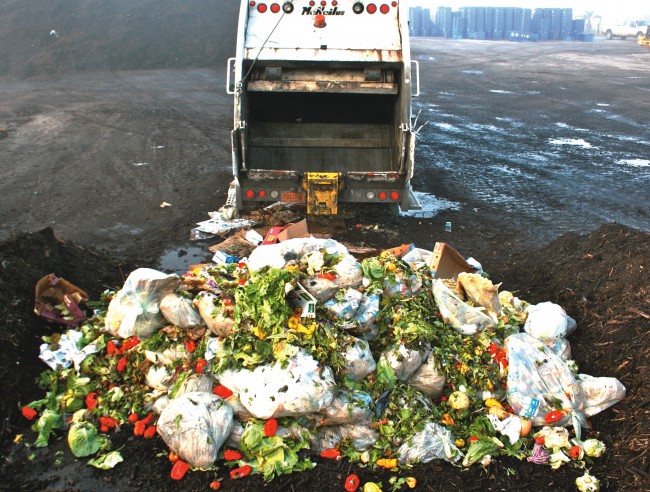
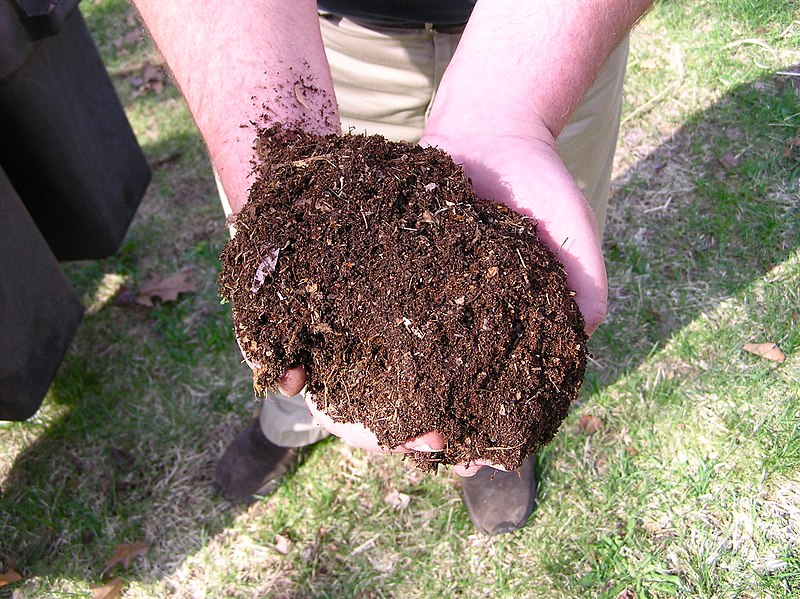
Composting, or systematically allowing food to decompose into usable and nutrative soil, has several benefits.  First, it allows us a place to divert some of the food waste we produce.  Also, the use of compost soil can naturally work to replace some of the nutrients in soil that are removed by agriculture.  Last, composting is relatively inexpensive.

Food Donation

Often times, a lot of the food we throw away is fresh enough that it could be donated to local food shelters and banks to provide food to people in our communities who can't afford it.  This can be complicated due to legal limitations and the process of transporting food to food shelters, but it is a very possible way to divert usable food away from landfills.

Industrial Uses

This is a rather broad use for food waste, but it essentially speaks to finding ways to use food waste in industrial settings, thus diverting the waste away from landfills.  Some options include:
  • Using food waste as a biomass source for energy production.  This is an innovative option that some corporations, such as Kroger, uses to power some of their stores.
  • Using food waste as feed for animals.  This is especially relevant as an option within the agricultural industry.
  • Using grease and fats as fuel.
 As always, none of these are a silver bullet-esque solution to fixing the problem.  The true problem is embedded in society.  But there are ways we can try to help.

And although I feel horrible about how much food I tend to waste at my job, some of the things Colorado State University does to be more sustainable is pretty cool.  A video in close.

Thursday, October 2, 2014

Growing Up and Growing Out

What Do You Want to Be When You Grow Up?

 I swear this question will become relevant in a few minutes.

My answer to this question has changed over the years.  I wanted to be a ballerina when I was little, followed by a teacher, and a CSI, and a computer person, and a journalist when I was in high school.  (I was something of a strange child.)  Somewhere in there, I decided I was interested in politics.

So out of this mess I ended up as a Political Science major as I entered college, and eventually I found myself attracted to Economics much the same way a moth is attracted to a light bulb.  And I love them both.

And while I refuse to believe that I'm actually grown up, from that I've settled on something else entirely:  urban planning.  I can now say that that is what I want to do when I 'grow up' (whatever that means). 

Now, my inner struggle of growing up isn't particularly germane to the environment, but urban planning is.

Urban Planning and Sustainability

Urban Sprawl (*insert dramatic scream*)

In a lot of modern urban planning practices, this image is tantamount to a movie poster for a horror film: 


 No, it's not a germ-y, bacterial blob.  Those are houses.  And this is an image of urban sprawl. 

Merrian-Webster defines urban sprawl as:
"A situation in which large stores, groups of houses, etc., are built in an area around a city that formerly had few people living in it."
 Now that sounds like the plot for a really (really) bad horror film.  But this type of building has several real consequences:
  • People drive more - one direct consequence of urban sprawl is that everything is more spread out.  Grocery stores are farther away from where people live, as are jobs, schools, and everything else people need to survive.  This spatial spread between all of these things typically means that people are unable to walk or use any alternative transportation to go about their daily lives; even if they wanted to.  This necessitates that people drive.  This leads to greater use of natural resources, and greater harmful tailpipe emissions that are bad for the environment.  Basically, it sucks.
  • People in the inner city have unequal access to jobs - as people move away from the inner city into sprawling suburbs and subdivisions, many of the jobs that were once located in the inner city move with the people.  This causes higher rates of unemployment among those who are unable to afford to move closer to areas of unemployment.  This distance further causes them to stay unemployed.
  • Uses an unnecessary amount of land - as people move outward into less densely-populated areas, they use an unnecessarily high amount of land to live on.  Which is sort of inefficient.

These are only several of the consequences.

But in swoops an Urban Planners' modern solution to this problem:  smart growth.

Smart Growth

Smart Growth is a concept often used by modern urban planners to try to curb the dastardly villain known as urban sprawl.  It is generally described by Smart Growth America as:
"Smart growth means building urban, suburban and rural communities with housing and transportation choices near jobs, shops and schools. This approach supports local economies and protects the environment."

How Does Smart Growth Work? / Areas of Sustainability


 Generally, Smart Growth works because it focuses on three areas that comprise this behemoth idea of 'sustainability.'  These are the areas:

Environmental Sustainability

Environmental sustainability is what people traditionally think of when they hear the 'sustainability' buzzword.  It is the traditional idea that all natural resources are precious and finite.  In the face of the degradation of these resources, and with increasing populations, it is the realization that we must be smarter about how we use natural resources.  It is the idea that less may need to be more.

Economic Sustainability

Economic sustainability is the concept of nurturing economies that help allocate resources among people somewhat fairly, while also doing so in a way that considers the environment and social equality.

Social Sustainability

Social sustainability is creating systems that are both environmentally and economically sustainable, while fostering culture that allows for a basic standard of living for all people.

 What Does That Mean?

It means that smart growth is using sustainable practices and land use planning to make better cities.  This approach moves away from economic rationality that pits individual freedom to own a house with a yard against the reality that all natural resources - land, clean air, and the environment in general - are finite.  It focuses more densely-populated areas, and on the placement of jobs and services near the areas where people live.  So they can walk, or take the bus, or ride a bike. 

And this access to cheaper transportation means that everyone has access to these services - not just people who can afford to have cars.

Which solves several of the problems that cause urban sprawl.

That All Sounds Nice...

...But does it really work?

And the answer is:  sort of.  This is merely a tool and concept used by urban planners to attempt to nudge cities in the right direction toward efficiency and sustainability.  But the reality of the urban planning field is that they can set the stage for all of these things to happen using both land use and zoning regulations.  But they typically aren't the one building new housing and businesses. 

Furthermore, even as the stage is set for this to occur, it takes time for the dreams of smart growth to be a reality. 

For the same reason that Rome wasn't built in a day.

Thursday, September 25, 2014

Marijuana Use and Negative Externalities

Amendment 64

Amendment 64 in Colorado, which legalized recreational marijuana use in Colorado for those over 21, has been perhaps produced the most interesting conundrum of legal issues in Colorado in recent history -- and it's not just the fact that marijuana is still illegal federally.

Cannabis Tourism (All Aboard the Canna-Bus?)


Legal issues aside, however, the legalization of marijuana has succeeded most in one area:  boosting tourism in Colorado, particularly those areas that have legal marijuana dispensaries such as Denver.  According to CNN Money, in the first half of 2014, Colorado took in $19 million dollars in tax revenue from legal marijuana alone, giving some idea to the magnitude of this industry.  Unfortunately, this number doesn't differentiate between in-state and out-of-state purchasers.  However, some dispensaries estimate that upwards of 1/3 of their business is from out-of-state tourists.

Issues with Cannabis Tourism

But the problem here?  This article brings up the fact that there really isn't anywhere for tourists to use their legally-purchased marijuana.  Some examples:
  • Out-of-state tourists can't go home and consume their marijuana - they aren't legally allowed to cross state lines with their marijuana
  • They can't consume the marijuana in the place where they buy it - it is illegal to consume marijuana at the dispensary which they purchase it at.  Also, dispensaries are not allowed to sell any other sort of cannabis-free food or drink, so they are not particularly destinations to spend time at.
  • Bars and restaurants are off limits - consuming marijuana, like cigarettes, is prohibited in bars and restaurants.  Outdoor patios are also off limits because Amendment 64 prohibits the use of marijuana out in the open in public.
  • But what about the hotel? - most hotels are smoke-free, and marijuana-smoke-free, as well.  They just don't want to deal with it. And they have that right.

What Does Economics Have to Do With This?

Negative Externalities

An externality exists when the market transaction - a consumer purchasing and consuming marijuana from a supplier - creates a consequence that affects an unrelated, third-party individual.  A negative externality is when this consequence adversely affects the third party.

When done publicly, consuming marijuana can thrust several of these negative externalities upon society, especially with regard to clean air.  For example:
  • People don't like the smell
  • The fumes do have the ability to adversely affect those who breathe it in (aka, a contact high)
Because of these various negative externalities, government regulation has been used to concentrate the use of marijuana into private spaces.  But this is complicated when marijuana tourists have a lack of access to "private" places.  And that's problematic with as large of as industry as cannabis tourism has become.

Fixing Negative Externalities

In a traditional sense, the easiest and most common fix to a negative externality is to make it more expensive, since negative externalities are caused by the fact that we consume a good or service at a higher equilibrium quantity than what we ought to demand, socially.  This expense comes from taxing things at higher rates.

The problem here, though, is the fact that the market price of marijuana is difficult to determine because it is such a new market.

So Where Does that Leave Us?

This leaves us in a place of business doing what they do best - sort of ignoring rules.  "420-friendly" concerts and events are becoming increasingly popular as a means of creating atmospheres for public marijuana use where the behavior is not condoned, but it is not prohibited either.  It's a gray area.  It's right where this issue lives best.

Other options are hotels and other "private" clubs and businesses where marijuana use is allowed as these establishments are not open to the public and therefore work around 'open-to-the-public' aspect that usually prohibits marijuana use almost everywhere else.

But like all else with this messy issue, as it comes to resolved, it will be nothing but interesting.

Thursday, September 18, 2014

Is Water Being Left Behind?


In many ways, water doesn't seem much different than oxygen.  It is necessary for life, it's almost everywhere, and it seems difficult to keep people from using it if it's there.  And in many ways, that's true.  But the key comes when the consideration of safe drinking water is added.  Then it becomes more complicated.

But before we get ahead of ourselves, we need to take a minute and look at two aspects of any good (or service).

How Goods Are Good (Or Something Like That)

Excludability and Rivalry

All goods and services can be characterized by two different characteristics:  excludability and rivalry.  These mean:
  • Excludability - the ability to prevent someone from using a good or service
  • Rivalry - the idea that if someone uses a good or service, then someone can't use it
In general, goods where you can prevent someone from using it is an excludable good; and conversely, a good where it is difficult to prevent others from using is called nonexcludable

Goods where the use by one person prevents another from using are characterized as rival, whereas goods that aren't depleted by one person's use are nonrival.

Setting the Table

We can combine these two traits together into a table, and through that we can come up with four distinct categories of goods/services:

Admittedly, each category of goods has its downfalls.  But the problems with public goods are perhaps the most prominent.

Which is where water comes back in.

Why Clean Water Is Important

 As mentioned above, water in and of itself is a pure public good.  It is incredibly difficult to stop anyone from consuming water of some sort.  Also, one person's use of the overall water system is generally non-rival because it doesn't prevent someone else from enjoying water. (Also, remember, the water you drink in modern times is just purified dinosaur pee.  Or something like that.) 

But what we are ignoring with the idea of water as a public good is the idea that people need clean drinking water.  They need water that is free of bacteria, microbes, and other things that can make them sick.  And without proper sanitation or resources, that is much easier said than done.  Now, clean drinking water is still a public good.  It is still relatively hard to prevent people from accessing clean drinking water, given both access points and cultural norms that establish clean drinking water as a right. 

But producing clean drinking water is expensive.  The market for this, left to its own devices, always delivers an unfavorably small amount of clean drinking water.  Which creates justification for government intervention to produce affordable and plentiful supplies of clean, municipal drinking water.

Missoula, MT

In truth, Montana is a bit of a weird state - that's mostly what I learned when I lived there for a couple months.  The stars at night are beautiful, I've never seen as many trees in my life, and beer flows freely (a lot like water).  And like any agricultural state in the Western United States, water is an especially important resource.

This is probably water, but it could be beer if it's in Montana.


Now, like almost every other city in the United States, Missoula, MT provides the service of providing safe, clean drinking water to its citizens.  But like many other cities, Missoula was also fundamentally affected by the recession in 2008.  As tax revenues to the city declined, providing the same amounts of services became difficult.  Even as economic conditions have improved, Missoula had fallen deeper and deeper in debt.  So they looked for ways to provide the same services at lower costs.

In municipal governments, this is often done through privatization of services, such as municipal waste, or water purification.  And this is exactly what Missoula did, as you can read about here.  Recently, the water rights for the entire Missoula Valley were sold to private corporation the Carlyle Group.  This has the potential to benefit Missoula citizens because privatization will likely lead to improvements in water infrastructure, and the same clean water for less money.  But the problem?  It's now a private company profiting, which makes water much more excludable than it was before.  And this shifts clean water from the public goods category into the club goods category.  And whether this will be good or not depends on several variables.  So we will see.

Thursday, September 11, 2014

The Solution to Your Evening Commute - An Economic Approach

I've seen this image posted on several websites already:


It is obviously a post geared at showing the benefits of alternative transit (buses, bikes, light rails, etc.), but it opens up the opportunity to talk about the greater topic that is transportation, and more specifically, traffic congestion.  

We all know what traffic congestion is:  it's what makes it inconvenient, annoying, stressful, and sometimes unsafe to drive places.  It is a pervasive problem in many urban areas around the world, and with increasing amounts of the world's population center shifting to urban areas, it seems increasingly impossible to fix this problem.

But it can be done.

But First...

Of course, first we have to ask one question:  how does traffic occur?  The Federal Highway Administration explains:
"Congestion results when traffic demand approaches or exceeds the available capacity of the system."
In translation, this means that traffic congestion is caused by the fact that the miles of road in the United States is relatively constant.  Even in the face of small increases in road miles every year due to construction, this finite space is divided into smaller and smaller portions with each new driver who backs out of their drive way.  The problem then boils down to the fact that traffic congestion is a side effect of the fact that there isn't enough road for everyone who wants to drive on it.


How Do We Fix It?

Traffic congestion is something of a many-faceted problem, and the true solution to improving traffic congestion in any community requires a myriad of tools.  But here we are back to discussing tools.  Not the type you can buy at Home Depot or Lowe's, but our handy, dandy Economic policy tools.  Let's begin to discuss some of the tools we can find in our tool box.


Increasing the Supply of Road

In many ways, the most straightforward policy tool one could suggest to alleviate traffic congestion would be to widen the roads.  Traffic congestion is caused by a lack of drivable space, so the quickest way to fix the problem would be to increase the amount of drivable area.  

Now the important part of any policy tool is to realize and weigh the pros and cons of each possible solution.  Let's discuss:

Pros

  • Keep it Simple, Stupid - It is the simplest, most straightforward way to fix the problem
  • Certainty - It is the most certain solution to fixing the problem
  • Keeps Taxpayers Happy - It is the most politically viable solution to be supported by taxpayers

Cons

  •  Construction Takes Time - Usually the best the construction of new roads can do is to keep pace with the problem
  • There Isn't Room - In some places with the worst traffic congestion, road widening is also the least feasible simply because there is not room to widen roads due to preexisting buildings and infrastructure
  • Well, I Used to Take the Bus... - Widening the roads may cause draw out induced demand by incentivizing people who used to walk, or take the bus, to now drive.  This means that widening the roads will only maintain the status quo as roads get wider, which does not help fix the problem.
  • Nobody Likes Construction - This speaks for itself.

Creating Legitimate Substitutes Goods

This solution works by creating goods and services that are legitimate alternatives, or substitutes, to driving and work to reduce the demand for driving cars.  This looks like reducing the number of vehicles on the road by finding ways to put more people in one vehicle, or by creating modes that don't use the road at all. 

Some examples:

Public Transportation

Public transportation is a network of transportation modes that provides service on fixed routes that run on fixed schedules.  According to the American Public Transportation Association, this goes beyond buses, though, to include some modes such as:
  • Light rails
  • Subways
  • Street cars
  • Ferries
  • Commuter trains
  • Trollies
  • And yes, buses

Bicycles / Bicycle Infrastructure
 
The encouragement of biking and the provision of adequate, safe bike infrastructure allows commuters the luxury of their own 'vehicle' and choosing their own route, while also providing a mode of transportation that is cheaper, more versatile, and an alternate to driving.  

Car Pooling / Ride Sharing
This alternative matches people who have relatively common departure and arrival areas to their commute, and allows them to commute in one vehicle versus the several vehicles that would be necessary if each person were driving their own car.  Furthermore, this option also allows individuals to split money for gas, and allows the driver to be compensated for wear and tear on their car in a way that may be profitable to them.

Assessing the Policy Solution

 Of course, each of these examples of creating substitute good to driving has its own pros and cons, though this group as a whole shares some common pros and cons.

Pros:
  •  Creates Alternative Options - Even though people may not want to drive, they are forced to if there is no other option.  Creating these other options is important to achieving the goal of reducing traffic congestion.
  • Reduces Harmful Tailpipe Emissions - This is a fancy way of saying that public and alternative transportation modes like these work to reduce carbon emissions either by exploiting economies of scale by putting more people in one vehicle or by using modes that produce fewer emissions - such a bicycle, which produces no emissions.
  • Creates Equal Access - Because many of these substitute forms are cheaper than owning a car, it works to create equal access to transportation for more people.  This is beneficial because it allows people to pursue better careers and educational opportunities than they may otherwise be able to.
Cons:
  • Public Goods - In conjunction with the fact that many of these modes are public goods, or are facilitated by public infrastructure, the truth of the matter is that they are not profitable ventures most of the time. Which makes them...
  • Politically Unpopular - People like public transportation once it is there.  They just don't like to pay for the investment to get it there.  This is typically a phenomenon known as latent demand, where demand is created for a good/service because it is there, rather than the supply being derived partially from preexisting demand.  This is complicated because people like the idea of moving forward with these alternatives, but they are less likely to come to fruition because there is not money to fund the projects.
  • Consistency is a Must - Admittedly, the one caveat to creating legitimate substitutes to driving is that these modes must be dependable.  With public transportation, this means that routes must be expansive, timely, and usually run through longer hours of operation.  Bike routes must be contiguous and create space for both bicyclists and cars to feel safe.  All of this is fighting an uphill battle at times both politically and financially.

 Price Incentives


The final tool economists possess that can help fix traffic congestion is the Duct Tape in the tool box discussed last week:  price incentives.  Because driving in this instance creates several negative externalities - pollution and traffic congestion - then the logical solution is to 'tax' driving and make the market price of driving more expensive.  Some possibilities include:
  • Increase Car Registration Fees
  • Increase Gas Taxes - Increasing the price of gas would incentivize people away from driving as much, and may prompt them to make alternative transportation choices such as those alternatives above.
  • Paid Parking - Paying to park in high-traffic, public places like malls, colleges, or downtowns works to make it more complicated to park once a consumer arrives at their destination.  This may make them rethink their form of transportation before they leave their house - especially if public transportation hubs are clustered in the same areas as paid parking.
  •  Initiating Tolls in Very Congested Areas- This assigns a cost to something that was a public good before.  By assigning a price to some of the most congested places, some people will still be willing to pay to use that stretch of road.  But other people will be willing to take alternate routes, or will choose other transportation alternatives.

Pros

As normal, there are pros and cons to be assessed with any group of policies:  
  • Choice - These mechanisms work to correct the problem while also providing free choice that people value very highly in most countries.  This goes away from telling people ho wot commute. 
  • Potentially Profitable - These mechanisms have the potential to be profitable and earn money to offset many of the issues that exist with driving, such as pollution, inadequate infrastructure, or other funding needs. 
  • Adjustable - Because these constructs are often intangible, they are relatively inexpensive to implement and are adjustable to changing tastes and needs in the economy.

Cons

  •  Responsiveness - People may not respond to the price incentives as expected.
  • Potentially Creates Socioeconomic Barriers - These price incentives may create further barriers to equal transportation for those who are lower income.

The Real Solution

The real solution to combating traffic congestion likely falls in the middle of these several policies, and a true solution uses a variety of these tools.  Unfortunately, Duct Tape may work somewhat well, but some chewing gum and maybe a hammer is necessary to truly fix the problem.  The chosen combination of these policies is very situational and depends on resources, culture, and political climate in a given community.  

Generally, though, the solution must make driving more difficult and provide a legitimate alternative to driving.  However a community chooses to implement this is variable, but the end should be the same.  That's the only way this is really going to work.

Thursday, September 4, 2014

Plastic Bag Bans and Economic Duct Tape

The City of Fort Collins just did something sort of weird.  In August, the Fort Collins City Council passed an ordinance that requires retailers to start charging for disposable bags, a.k.a. plastic and paper bags*.  The fees go into affect on April 1, 2015.  You can read the entire ordinance here or a more palatable FAQ here, but the main points are:
  • Retailers are to charge customers a minimum of $0.05 per disposable bag they use.
  • The fee will go to the retailer.
  • At least 50% of the fee must go toward providing free reusable bags to customers as the retailer sees fit.
  • Retailers must get permission from the customer to give them disposable bags.
  • Some exceptions to this rule include:
    • Restaurants
    • Farmer's Markets
    • Bulk items
    • Bags containing raw meat, frozen foods, or unwrapped items such as bakery goods
    • Prescription medicines
    • Newspaper delivery bags
'Bans' like these are not entirely new.  Over 133 communities around the United States already have a similar ban in place.  Several examples include: Austin, TX; San Jose, CA; Washington, D.C.; Basalt, CO; Boulder, CO.  Speaking to the success of these fees for plastic bags, Boulder, CO has reduced their use of disposable bags by 68% since their $0.10/bag fee went into effect in July of 2013 (see information here).

But why is this a concern?  Why is this a thing?

Plastic Bags are Bad.  
Each year, we use billions of them as a planet.  Disposable in nature, these bags accumulate in landfills, or blow away in the wind and end up as litter and trash in the ocean. This pollutes our oceans, and make it easy for wildlife to mistake the plastic deathtraps as food, which doesn't do much for their digestive systems.  Furthermore, these bags take a very long time to decompose in landfills.  Even though this is a very rough description of the problem, all of these factors mean that the problem is only growing as time progresses.


So again:  plastic bags are bad.  And it seems like the simplest solution would be to simply stop using them.  Ban them.  Prevent people from using them to carry their groceries and purchases home.  

But it isn't that simple for a couple of reasons:
  • People don't like being told what to do.  People don't respond well to being outright told what they can and can't do.  They want to be asked if they want their milk in a bag at the grocery store.
  • People need to carry their purchases in something.  Think of something as simple as going to the grocery store.  Think of how full your basket is as you wheel it toward the check out stand.  Now think of how you would get all of that home without something to carry them in.  And then try and figure how you would do that on the city bus, or on a bike.  Yeah...
  • Plastic bags are cheap and convenient.  It is simple to suggest the solution of switching to another reusable or more recyclable/decomposable container to carry everything in.  This is the best solution, of course, but plastic bags are so cheap and convenient.  Plastic bags ensure that people don't need to remember their reusable shopping bags every time they need to stop by the store.  They are cheaper than boxes or paper bags.  In short, they are the cheapest solution to people's laziness and forgetfulness.
But they are still bad.  So if we can't ban them, then how can we get people to stop using plastic bags?  

Economics Has an Answer (And Duct Tape)

 
If Economists had tool boxes, incentives would be their duct tape.  Incentives can fix everything (except a leaky pipe). 

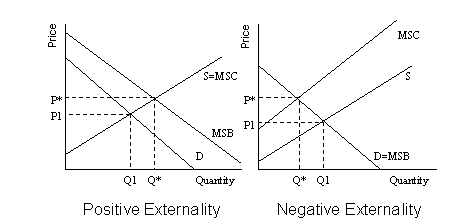
Externalities
In society, there are times when we demand more of a good or service than we really ought to.  Examples of this include fast food, or cigarettes.  The opposite is also true, where we don't demand as much of something as we ought to.  This happens with things like education.  The technical term for this phenomenon is an externality.  For all you budding economists, you can see this concept in this chart:


Now Back to Discussing an Economist's Duct Tape
The concept of the Economic incentive is typically put into action through government policy that hits people/corporations where it often hurts the most - their wallet.  In the simplest terms, this looks like using taxes to increase the market price for things that are bad for society - like pollution - and provide subsidies to make good things cheaper - like education.  This use of incentive causes the equilibrium quantity of 'bad' things to decrease, and the market equilibrium quantity of 'good' things to increase.

What does that have to do with plastic bags?
It is clear that society demands too many plastic bags.  With the previous section in mind, one logical policy solution to incentivize people away from using so darn many plastic bags is to charge money for them and assign a cost to the convenience they provide.  Within this, some people will still be willing to pay a price for the convenience they provide, but other people will choose to avoid paying for plastic bags by bringing reusable bags or other containers to carry their purchases in.  Depending on how expensive those bags are, more people may make the choice to start bringing their own bags. (In Economics-speak: basic supply and demand.)

The result?  Those people who are bringing their own bags aren't using the plastic ones, which leads to fewer plastic bags left to float away in the breeze.  Huzzah, victory!  (We deserve a gold star.)


Assessing the Pros and Cons
Of course, as with every policy solution, there are pros and cons to this policy solution.  Here is a summary:

Pros:
  • People use fewer plastic bags.
  • Pollution is reduced.
  • Reusable shopping bags are less likely to break compared to their thin, plastic counterparts.
  • People have a choice in whether they give up plastic bags or not.
Cons:
  • People may forget their reusable shopping bags at home, anyway.  I know I do.
  • With regard to cloth reusable shopping bags, if they are not regularly washed, it increases the chance of spreading food-born illnesses such as Salmonella if other foods are put into bags that once contained raw meat or vegetables.
  • They cost money, which may create an additional burden on low-income individuals and families.
 So in short, that's why the City of Fort Collins wants to ban plastic bags.  And paper ones, too.


*This article primarily discusses why plastic bags are bad, even though most 'bans' address both plastic and paper bags.  Plastic bags are worse than paper bags in terms of environmental sustainability, yes.  Although paper bags are recyclable and biodegradable, they are still targeted by these bans because they create waste and they create incentive to use some sort of disposable bag.  Also, the processes used to make paper bags is relatively resource-heavy.